
Extreme Heat and Extraordinary Solutions: Notes from London Climate Action Week
25th June 2026
Ironically, as the climate gets a little too active, this week is London Climate Action Week. Earthwatch has been very involved, as has our CEO Harry Barton. Here, he shares his reflections of the week and what he learned.
While my colleagues were organising our well-attended film screening in Hackney, I was in another part of London spending an inspiring two days at the London Climate Action Week, including a day at the Earthshot Prize Impact Assembly. It was hot. So hot that not everyone could bear sitting in the Nature Tent in the courtyard outside and even the speakers seemed to be flagging as the afternoon progressed.
So hot that we had to cancel most of our Earthwatch events for the week because we felt it wouldn’t be safe to have children outside for more than a short spell. In fact, most schools are shutting down anyway as children struggle to work in the sweltering classrooms. It’s a stark reminder of how poorly equipped we are to deal with the extreme heat that may well be the summer norm within two decades.
Weather aside, I met some extraordinary people. I chatted to someone who had recently rowed across the Atlantic and then around the UK (which is apparently even tougher). Someone who had invented zero carbon concrete, which has recently been used in 50 construction projects including building a new motorway. Someone who is rolling out a new technology to pump carbon dioxide into deep rocks where it is stored safely and securely. We heard about the largest mangrove restoration project in the World, a project to filter out microplastics, the world’s biggest battery that could revolutionise energy grids.
These are all incredible achievements from amazing people. But they are still exceptions in a world that dedicates vast subsidies towards the destruction of nature. As one speaker put it, why do we only seem to value life when it’s dead – tonnes of fish in a trawling net, timber piled up on the back of a truck? And while the great majority of us say we love nature, why do such an alarming number of us regularly vote for political parties intent on getting rid of all the laws that protect it? Part of the answer is that nature is still widely seen as a nice to have, something to enjoy in the good times, but not a serious contender when it comes to making choices about inflation, employment or the business bottom line.
This is where is got really exciting, because there are some out there who are starting to think differently. Companies like PepsiCo are investing heavily in sustainable agriculture because they see it as key to their business long term. The State of Gujarat in India, an Earthshot prize finalist from last year, has pioneered the world’s first trading scheme for particulate emissions, letting businesses keep growing while providing clean, healthier air. The scheme has been so successful it’s being rolled out to other cities in India, and Rio de Janeiro is soon to follow. Regreen in Brazil is another hugely ambitious initiative, with government support, to scale up regenerative agriculture, restoring degraded land and removing the reliance on fossil fuels for fertilisers and other inputs.
“We don’t have the luxury of guilt, gloom or pessimism.
The imperative for all of us is to act, and act now.”
These companies and governments aren’t just doing some good work on the side – they’re operating under a new set of assumptions; that nature and climate are fundamental to managing risk, delivering a high-quality product and making a profit. And their actions are underpinned by more than just great ideas, but by the kind of scientific data we generate at Earthwatch with the help of thousands of dedicated citizen scientists.
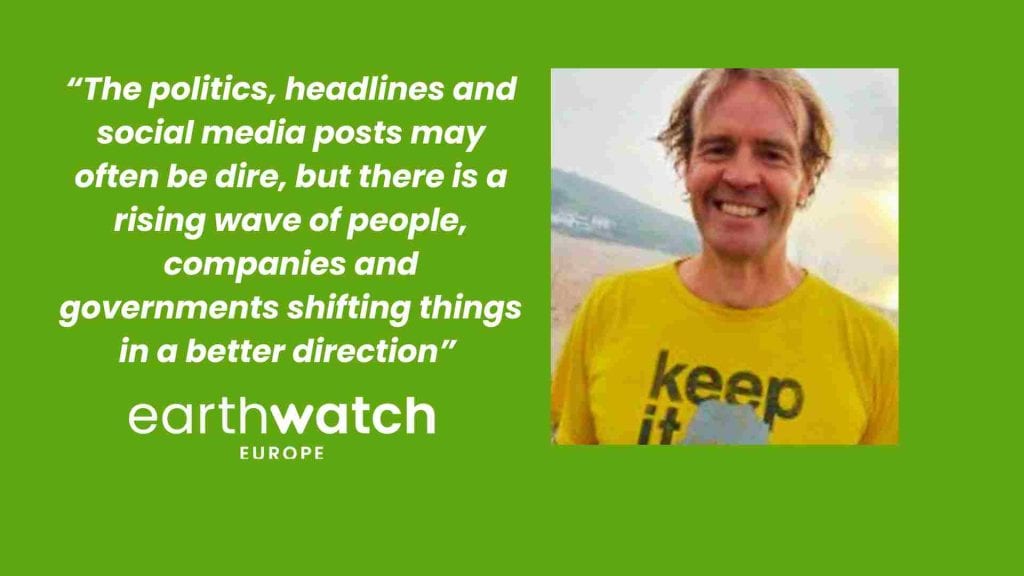
The politics, headlines and social media posts may often be dire, but there is a rising wave of people, companies and governments shifting things in a better direction. As always, it starts with small groups with big ambitions and exceptional courage. But if the evidence shows that these new approaches work – which it does – there is no reason why that can’t be spread to other areas and scaled up even further.
To paraphrase a quote from that week I’ll remember more than any other: we don’t have the luxury of guilt, gloom or pessimism. The imperative for all of us is to act, and act now.