
Think long term, act now: the thinking behind our New Strategy
26th October 2026
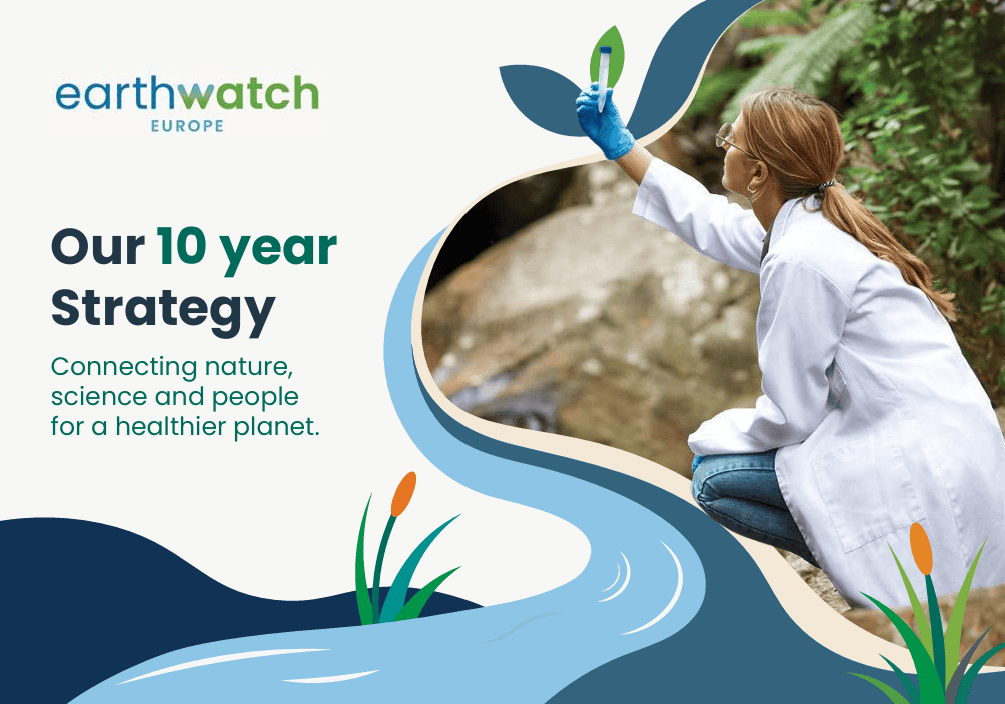
Earthwatch CEO Harry Barton explains the thinking behind our new strategy, why long-term vision matters in an uncertain world and how putting science, communities and nature at the heart of our work can help create lasting environmental change.
Read and download our new strategy here>
“Imagine if every street in your local town or city was lined with healthy trees; if your local river ran clean and the air you breathed was pollution-free and carried only the scent of the seasons. If wherever you live, you had the chance to learn about nature, visit wild places and experience the thrill of the dawn chorus or an arid landscape bursting into life after the rains.
If with nothing more than a simple and affordable handheld device, you could understand the birds and the plants, and actively monitor the health of your local rivers, soils and wild places. If you could easily share that knowledge with communities across the world and could use it to stand up for your local environment so that nobody dared mistreat it. And if governments, companies and others in positions of power stopped to listen and took long-sighted decisions based on that knowledge and evidence.“
These are some of the opening words of our new Strategy. In a troubled World, every charity must ask itself what its role is in making the Earth we live on a better place, and what makes them stand out from others in their efforts to do this. The words above hopefully throw light on Earthwatch’s position at the nexus of the natural environment, community and science. We don’t just seek to stand up for nature; we stand up for truth and fact, rather than rumour or myth. We believe science can and should be at the heart of every decision about our collective future, and we believe democratising knowledge is central to this. It’s a thrilling but daunting challenge.
“The best way to thrive during these testing times is to have a very clear sense of direction and purpose, establish clear priorities and stick to them.”
Autumn may feel like a strange time to be launching our new Strategy because we usually think of it as a time of slowing down. Personally, I’ve never found autumn to be quiet though, either in the office or in the world outside my window. On the surface, it may appear to be the season of mellow fruitfulness, but in nature there is a sense of subdued urgency, as if the clock is ticking. Neither we in our warm homes nor the birds busying themselves on the damp grass know what’s just around the corner. As I write this, the first storm of the winter has just passed over, ripping leaves off the trees and demolishing any last remnants of a long summer’s tranquillity.
We’re living through a period of rapid and unpredictable change. The challenges are volatile, uncertain, complex and ambiguous, with artificial intelligence and funding shortages adding further layers of complexity. How do we navigate such a potent cocktail?
Strategies are as much about a mindset as they are about anything written on paper or displayed on a screen. They challenge us to lift our gaze to look beyond what we can see, to imagine what we don’t know, to place ourselves in a distant time that we may never be part of. With so much uncertainty around, some may well ask what is the point of making long-term plans? Surely our efforts are better spent finding every last penny of funding, of getting through the near-impossible list of tasks right in front of us?
“We aim to grow a global community of scientists, ensuring that both experts and non-experts in every country where we work can take part in science and engage directly with the natural world.”
The tendency of most of us in these circumstances is to focus on surviving today and, if we have a spare few minutes of calm, to reflect briefly on how we’re going to get through tomorrow. Our sightlines can easily shrink geographically too. But evidence shows that the best way to thrive during these testing times is to have a very clear sense of direction and purpose, establish clear priorities and stick to them. Of course, the journey to the destination will be in small steps, and it may not be linear – every great survival story confirms this, from Ernest Shackleton’s epic journey back from Antarctica to Simpson & Yates’s impossibly dramatic return from a doomed mountaineering expedition, vividly told in Touching the Void. It’s where those steps take you that matters though.
We’ve attempted to reconcile this tension in our Strategy by including different time horizons. We ask ourselves the difference we want to make on a generational timescale, in a decade, and in the next three years. The 25-year challenge asks how we want to make the world a better place for the next generation. So, for example, we aim to grow a global community of scientists, ensuring that both experts and non-experts in every country where we work can take part in science and engage directly with the natural world.
Ten years is a clearer destination to aim for, allowing more specificity, although the route may not be entirely clear at this stage. Among other things, we want our Great UK Waterblitz to spread across Europe. We want to support communities in ten sub-Saharan African nations to build skills and capacity in environmental monitoring of biodiversity, water quality and soil health, and ensure the data are used to shape the policies of the future.
The next three years are what we can focus on now, with the resources at hand. Our priorities include expanding our freshwater monitoring to include PFAS (“forever chemicals”), road runoff and heavy metals; and we’ll work with mental health organisations to explore nature connection through programmes combining field research and support for individual wellbeing.
None of this can happen without change within Earthwatch. To paraphrase leadership guru Stephen Covey, the private victory has to come before the public one. So, we’ve set challenges for ourselves too. Delivering a step change in our income generation, building a strong and effective supporter base and making effective use of technology in everything we do are just some of these.
This is incredibly exciting. Will we achieve it all though? Of course, I hope we do and believe we can, even if it takes us longer than ten years. But perhaps that’s not the question we should be asking right now. Ten years hence it will be different people holding the baton, with different circumstances to deal with. Our job now is to focus on those goals, prepare ourselves for those crucial first steps, align with our partners and ensure we’re fit to take on the challenge.
“It’s a thrilling but daunting challenge”
That leads to what is perhaps the most important thing of all – our values. At Earthwatch we’re a strong team, with deep roots and close links to each other. That gives us a firmness that has held us together through challenging times. Looking ahead, we’ll need to balance this with a desire for change, an openness to the genuinely new and the unfamiliar. Like all tensions, it can be uncomfortable. But if managed well, it can be creative, exciting and lead to genuine success. And it’s that success that will ultimately make a difference out there and make our efforts worthwhile.