What is a Miyawaki forest? The science behind Tiny Forests
2nd December 2025
Since 2020, Earthwatch Europe have been pioneering the Miyawaki forest planting method in the UK, through our Tiny Forest programme.
We treat every Earthwatch Tiny Forest as a ‘living laboratory’. This allows us to research and better understand how the Miyawaki method works within the UK landscape and in urban settings.
We aim to bring the benefits of Miyawaki forest planting to urban communities, as well as researching them, including:
- Fast growth: trees that grow much faster, jump-starting the forest creation process and capturing more carbon.
- Rapid maturity: the creation of stable, multi-layered forest communities similar to natural forests.
- High biodiversity: nature-rich spaces that attract more wildlife.
- Nature-based solutions: benefits like urban cooling, reduction of flooding, and improvements to air quality, all while boosting local community wellbeing and nature connection.
This blog explores the science and the impact of this unique approach to tree planting.
What is the Miyawaki forest planting method?
The Miyawaki method is a unique approach to tree planting developed by the Japanese botanist and plant ecologist Professor Akira Miyawaki in the 1970s.
Having witnessed the fragility of monoculture plantations (forests consisting of a single species), Dr Miyawaki developed an approach to restore indigenous forests on degraded land.
Unlike traditional forestry, which often focuses on timber production or aesthetics, the Miyawaki method prioritises the restoration of a functional, native ecosystem.
The core principles
To be classified as a true Miyawaki forest, planting must follow these principles:
- Potential Natural Vegetation (PNV): we only plant species that would occur naturally in that specific area without human intervention. This ensures the trees are adapted to the local climate and soil conditions.
- Soil preparation: if needed, the ground is prepared to mimic the loose, nutrient-rich soil of a mature forest. We use organic compost and mechanical turning to reduce compaction and improve oxygenation.
- High density: saplings are planted at a high density – typically 3 to 5 trees per square metre. This density triggers a natural competition for sunlight, encouraging the trees to grow upwards rapidly rather than outwards.
- Multi-layered structure: we do not just plant trees; we plant a community. A Miyawaki forest includes four distinct layers: shrub, understory, sub-canopy and canopy trees.
The connection: Earthwatch Tiny Forests
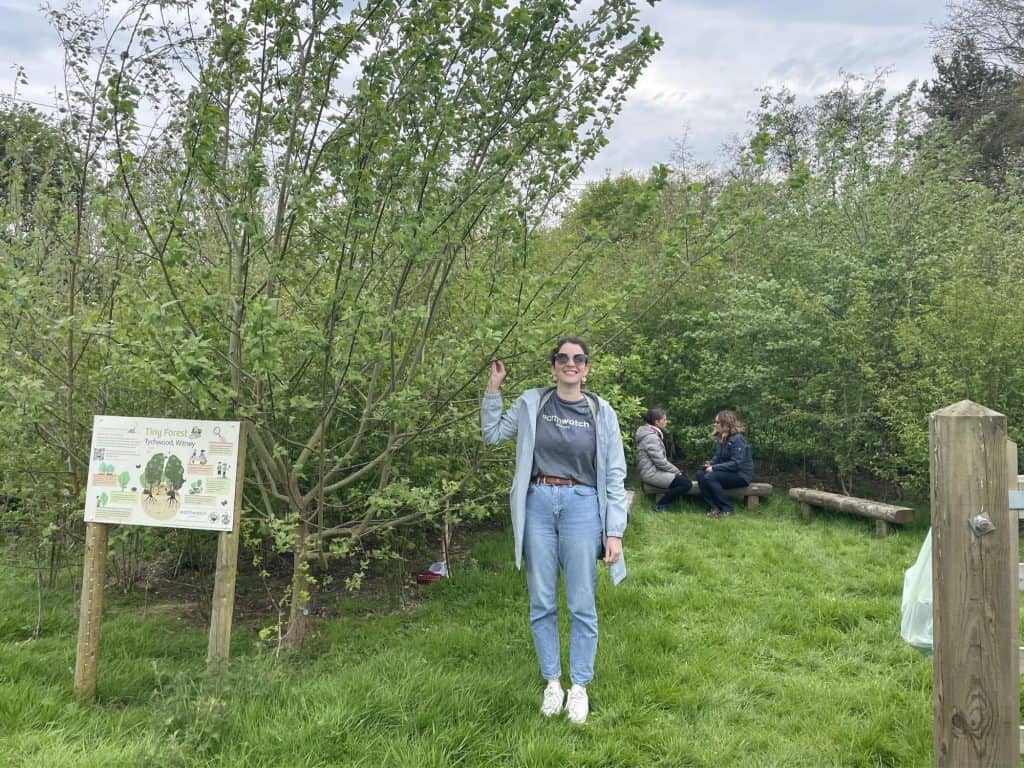
At Earthwatch Europe, we have adapted the Miyawaki method to create our Tiny Forests. A Tiny Forest is a dense, fast-growing native woodland, about the size of a tennis court (approx. 200m²) planted in urban areas.
While the footprint is small, the impact is significant. By bringing the Miyawaki method into urban spaces – school grounds, parks, and unused council land – we are creating miniature woodlands that reconnect communities with nature while providing environmental benefits.
Fast growth and higher survival rates
Evidence is showing that trees planted using the Miyawaki method grow faster and have higher survival rates than those planted following traditional methods.
The Trees Outside Woodland programme found trees in Miyawaki forests were over 1.5 times as likely to survive the first two years than if planted using traditional methods.
We partnered with Coventry City Council to compare a Tiny Forest planting with traditional planting. After six months, in the Tiny Forest, 95% of trees were still alive; whereas in the traditional planting, shockingly no trees survived.
Tiny Forest trees grow faster. For example, the tallest tree at a Tiny Forest measured this year was a four year-old wild cherry, in Hammersmith Park, which reached 540cm! Wild Cherry trees normally grow 30-60cm per year. But this tree has been growing over 100cm a year.
These early results suggest that Miyawaki forests can offer a more resilient way to establish trees in urban areas.
Professor Miyawaki’s own research showed that these forests grow incredibly fast, quickly creating a thick canopy that shades the ground, similar to natural forests (Miyawaki 1999).
The soil preparation plays an important role in enabling this fast growth. Compact soil stunts root growth, stressing out trees. By loosening the soil before planting, we give the roots plenty of room to grow.
The impact: what the data tells us
At Earthwatch, we don’t just plant trees; we monitor them. Thanks to our network of citizen scientists and Tree Keeper volunteers, we have gathered extensive data on our Tiny Forests across the UK.
Their contributions provide insights into how these forests function, how quickly they develop, and what benefits they offer to people and wildlife.
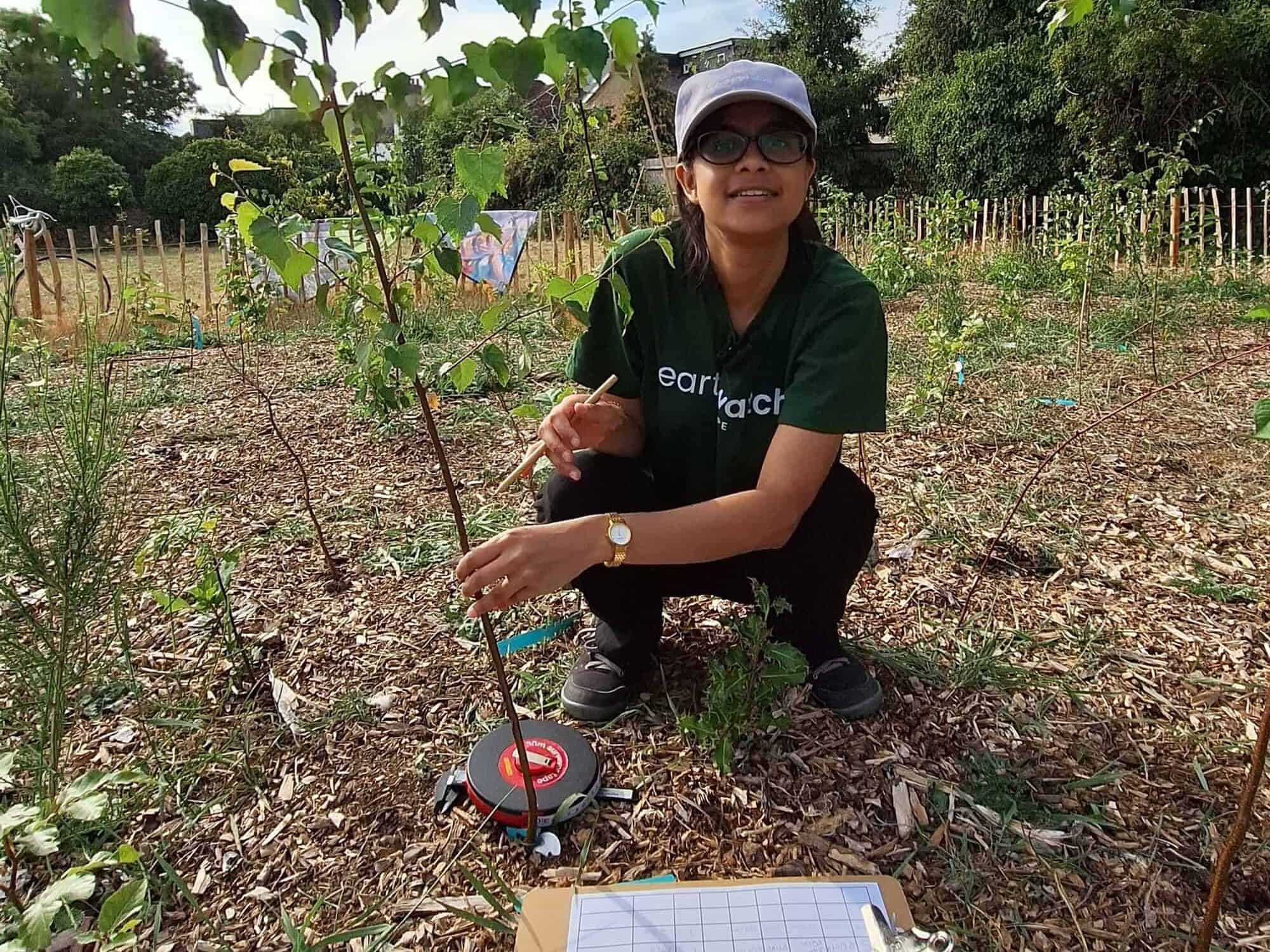
Here is what our data reveals about the impact of the Miyawaki method in urban settings:
1. Urban cooling
Cities suffer from the ‘urban heat island’ effect, where concrete and asphalt trap heat. The dense canopy of a Miyawaki forest provides cooler spaces in cities.
- Our data: we have recorded air temperatures up to 6°C cooler inside a three-year-old Tiny Forest compared to the surrounding environment.
2. Flood management
Climate change is increasing the frequency of heavy rainfall. The deep, loose soil structure of a Miyawaki forest acts as a sponge, better at soaking up water.
- Our data: water infiltration rates are up to 28% faster inside a Tiny Forest compared to the surrounding land. This significantly reduces surface runoff and lowers pressure on urban drainage systems.
3. Carbon sequestration
Fast growth leads to fast carbon uptake. As the trees race for the light, they pull carbon dioxide from the atmosphere and lock it away in their biomass (branches, trunks, and roots) and the soil.
- Our data: monitoring has shown roughly a 168 fold increase in carbon stored, because trees planted with this method grow exponentially at this age.
4. Biodiversity boost
A Miyawaki forest is not just a collection of trees; it is a home. The complexity of the four-layered structure provides varied habitats for wildlife, from ground beetles to birds.
- Our data: surveys consistently show that these forests support a diverse range of pollinators, including bumblebees and butterflies, and ground-dwellers, such as worms and frogs. They also provide homes for less commonly seen urban species such as newts, solitary bees and slow worms, offering a refuge in nature-deprived urban areas.
5. Support wellbeing and nature connection
Access to nature is linked with better health and wellbeing, with green spaces helping to bind communities together and reduce loneliness. Outdoor learning boosts confidence, social skills, communication, motivation, physical skills, knowledge and understanding in children. Tiny Forests are nature-rich spaces where people can rest, play, learn, connect with and give back to their community.
- Our Tree Keeper volunteers report that spending time in Tiny Forests helps their wellbeing.
“Because the space has a lot of history, a lot of senior residents around the park feel very connected with it. We also have a lot of young families here like my family. We felt that it’s a great space for the local children to come and play. Living in London can be a challenge because of the traffic and pollution, but we felt like we do have an opportunity here to create a space where they can learn from nature that can contribute to the environment, and they have a nice time with the friends. For me, it’s a great space for my wellbeing, to relax after a stressful day at work and do some weeding.”
– Mina, Tiny Forest Tree Keeper at New Road Park
The Miyawaki Research Network (MiRN)
Earthwatch Europe leads the Miyawaki Research Network (MiRN), an international group of researchers exploring the development and usage of tree planting using the Miyawaki method and its variations.
The aims of the MiRN are to:
- Demonstrate leadership in Miyawaki research by connecting practitioners and researchers involved in applying/assessing the efficacy of Miyawaki woodlands.
- Support knowledge creation and provide sustainability beyond the initial years. The MiRN will promote research collaborations and seek funding for projects across disciplines.
- Maximise impact by working collaboratively to ensure compatibility and consistency between monitoring and research approaches to enable comparative analysis.
- Provide innovation and collaboration between partners to develop best practice approaches based on a sound evidence base with good understanding of the trade-offs.
- Be a go-to source for anyone looking for expertise on Miyawaki approaches.
Everyone is welcome to join the network. Get in touch if you’d like to find out more.
A small solution for big problems
The Miyawaki forest method is more than just a planting technique. By working with nature, we can create resilient, nature-rich spaces right on our doorsteps.
Tiny Forest demonstrates that we do not need vast acres of land to make a difference. With the right approach, a plot the size of a tennis court can become a powerful nature-based solution that benefits people and wildlife.
Want to see the science in action? Discover more about our research, find your nearest Tiny Forest, or sign up to become a Tree Keeper volunteer. Together, we can make our cities greener, healthier places to live, work, and play.
Support Tiny Forest by sponsoring a tree!
From just £10, you can sponsor a tree in one of our 290+ Tiny Forests across the UK and support a thriving wildlife haven in an urban community.
Choose your favourite native tree species, receive a personalised certificate, and give a gift that truly gives back. Whether for yourself, a loved one, or to mark a special occasion, your sponsorship creates lasting impact for wildlife, communities, and our planet.

About the author
Dr Claire Narraway is Cities Research Lead at Earthwatch Europe. Her academic background spans psychology, zoology and evolutionary ecology, culminating in a PhD at UCLA investigating how selection at different levels shapes conflict within bee societies. She later held a postdoctoral post at University College London, probing how biological ideas are used in urban planning.

About the author
Sally-Ann Smurthwaite is Digital Content Manager in Earthwatch’s communications team. A passionate science communicator and naturalist, she has 10 years of experience working in environmental organisations, engaging people with nature. Sally has a social science MSc in Environment, Science, and Society from University College London.